



I don’t believe in ghosts, not really, but I do believe what happened in that house in Normandy. Picture it: it was a long stone farmhouse set on the edge of a small village in the middle of the French countryside, and it was where my boyfriend, Jack, had grown up.
The first time I visited, Jack’s father, Robert, met us at the train station, smoking a cigarette on the platform as our train rolled in. I’d never met him before and I was nervous. But back at the house, he showed me, in his gruff, country way, the garden with the pond and the two-car garage where he kept his vintage Triumphs, and I began to relax. The inside of the house was just as charming, with a kitchen covered in Delft tiling and a living room with a red couch and a fireplace.
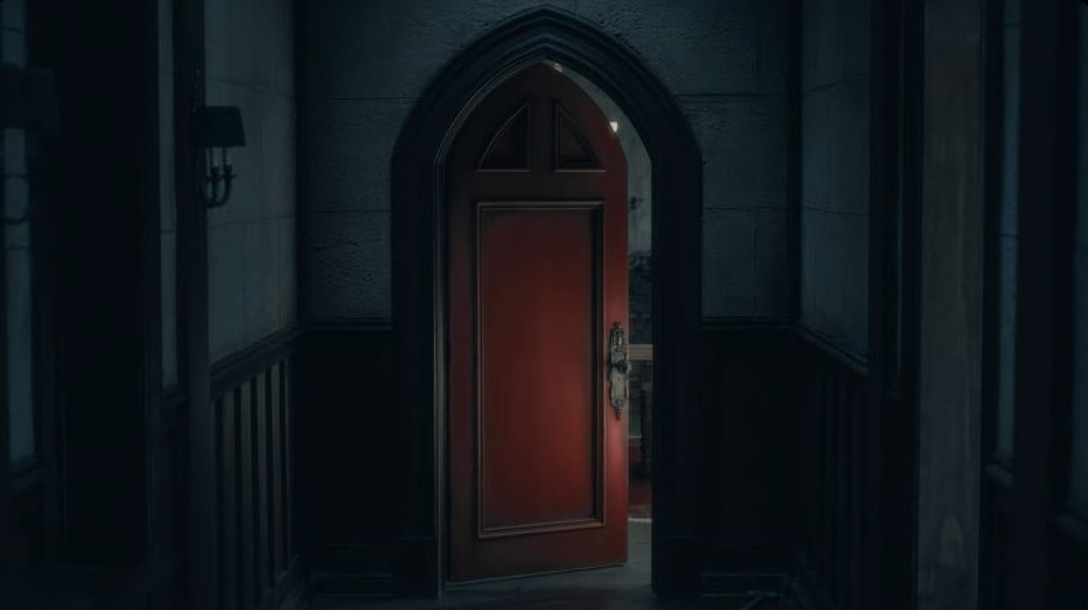
On the second floor, a long hallway stretched from one end of the house to the other, with a row of closed doors that Jack gestured to breezily. “There you have the bathroom,” he told me, “then the water closet, my dad’s room, and here,” he swung open the door to our right, “is my room.” His room was a relic of his childhood, with a three-piece stereo, a four-poster bed, and photos of him and his friends tacked to the walls. It was cozy and warm, just like the rest of the house, and I secretly fantasized about raising our kids there one day. I loved everything about the place: everything, that is, except for the last door at the end of the hallway. Jack hadn’t mentioned it and some instinct told me not to ask any questions, so I held my tongue.
I held my tongue even when another instinct followed me all weekend, like a shadow: the uncomfortable feeling that I was being watched, that someone was observing me from the end of that long hallway. But I’m getting ahead of myself.
At breakfast the next morning, Robert told his son, “Maybe you can bring Annabelle to the cemetery today.”
“I don’t know,” Jack replied. “We’ll see.”
“I’d like to go,” I said, but Jack just shrugged and took a sip of his orange juice.
Still, that afternoon, he brought me.
His mother’s grave was simple and set in a quiet corner of the village cemetery. Fresh flowers had been placed on the tombstone, and their vibrant colors felt off, too alive for this site which clearly was neither visited by many of the living, nor added to often with the dead.
It had been 15 years since Jack’s mother had passed. Robert visited the tomb every Sunday, bouquet in hand, but what I didn’t know at the time was that my visit with Jack was only the second time he’d been since her death. In the years that would follow, we would never return to the cemetery, I would never hear Jack tell a story of his mother, and I would only ever see one picture of her, a dark and grainy one that sat on a shelf in his father’s kitchen. A cousin would later admit to me that 12-year-old Jack hadn’t shed a tear at the funeral. I came to the quiet conclusion that Jack had done everything he could to prevent his mother from becoming a ghost to him: she was just a woman who had left and never come back, disappearing into nowhere, becoming nothing. Or so he liked to believe.
On our second night at the house, I went up to Jack’s room to fetch a sweater, for the night had grown cold. I was pulling the sweater over my head, when I felt it again: the feeling that I was being watched. I yanked my head through the collar, but found no one in the room. I peered into the darkened hallway, and saw nothing either. And yet, I did something that surprised even me.
“Please leave me alone,” I whispered into the air. “I promise I come in peace. I love your son, and I’ll never hurt him.”
I spoke these words softly, not wanting to fully own what I was doing, and definitely not wanting Jack to find me speaking to myself. But the whisper must have been loud enough, for, as soon as I said the words, I felt the presence down the hall step away, and I was overcome with relief. Now, I know what you’re thinking: by speaking my fear out loud, I had robbed it of its hold on me. That is the logical explanation. And for the next five years, that’s what I told myself, as well.
But then, I broke my word. I was on the cusp of turning 30 and — call it what you will, Saturn Return, quarter-life-crisis… we’re always desperate to label the things we don’t understand — I came to the painful realization that Jack and I needed to end things. When I told him this, through body-shakes and tears, he murmured, “It’s ok,” and took me in his arms, holding me while we sat with this horrible, unwelcome truth.
Before we parted ways, though, we decided to do one last weekend in the country. Maybe we were hoping to rediscover some of the peace and happiness we’d always known there. In reality, we were fooling ourselves, and everybody knew it. Everybody.
That Friday, we packed our bags and took the train, arriving to the familiar sight of Robert waiting for us on the platform, cigarette in his mouth. Like we’d done for the last five years, we shopped at the market, walked along the river, and prepared dinner in the kitchen as rain pattered at the windows. On the surface, things were as they’d always been, except for one relatively new addition: winding about our ankles was Newton, the puppy Robert had adopted six months earlier. Newton was a hunting dog with sharp instincts, and when the three of us sat down in front of our steaming plates of bolognese, he sat on high alert, keeping a beady eye out for any scraps.
We picked at our food in silence, trying to ignore the fact that we were faking our way through the charade of a last happy night together, but I could feel Jack sagging with abandonment, and could sense Robert crisping, protectively, opposite his son. For my part, I was awash in guilt and sadness.
That was when Newton started barking.
“Newton, hush,” Robert said. Puppies, we sighed, and returned to our plates. But then, Newton’s bark turned to a growl, the hair on his back raised, and he began to circle the table, his eyes riveted on a spot above our heads. We looked up, searching for a moth or a crack in the paint, but there was nothing.
“That’s enough,” Robert snapped. “Go sit in the corner.”
Newton, usually an obedient dog, ignored these orders and started jumping and nipping at the air, his eyes fixed on that same spot on the ceiling.
“I’ve never seen him do this before,” Robert said.
“I don’t get it,” Jack said, craning his head upwards. “There’s nothing there.”
But, of course, there was something there, and ice was running through my veins at the knowledge. You see, in the years since my first visit to the house, I had learned what lay at the end of that long hallway upstairs, behind the locked door, in the darkened room that sat above us now: it was where Robert kept all of Jack’s mother’s things, things he refused to get rid of. Jack found this ridiculous, his father’s vain attempt to hold on to something that had slipped away forever, but I’d always sympathized. The things is, though, when something is well and truly over, you have to let it go.
As the dog continued to bark and nip at the air, as Jack tried to calm him down, and as Robert stood to inspect the ceiling more closely, I remained frozen in my seat. “I’m sorry,” I said in my head. “I never meant to hurt him. And, for what it’s worth, I really do love him.” I knew it wasn’t my apology she wanted, though. She was just telling me to do what she couldn’t: to leave her boys alone, and make myself even more of a ghost than she was.
 | A guest post by
|